

From SurfPerch to Big Sur Rockfish: California Shore Fishing Adventure ft. Jim's Pro Bass
This blog is available as a full length video on YouTube, you can find it here or on my channel @VINCEGOESFISHING
1. FROM SAND TO CLIFFS
Some trips cover a lot of ground.
This one covered a whole coastline.
We start on a sandy beach in Pismo, CA chasing surf perch.

Then we head inland to Jim's Pro Bass in Paso Robles.
Then it's on to the rugged cliffs of Big Sur, for one of the greatest shore fishing adventures on the West Coast.

From smooth sand to steep, unforgiving rock ledges.
Olive rockfish.
Grass rockfish.
Lingcod.
Black and yellow.
And a first ever for me: a black rockfish.
Along the way, rare albino sea anemones, tidepool life, and things I'd never seen before.
Because this trip is about more than catching fish.
It's about exploring one of California's wildest coastlines, and the incredible diversity that exists where land meets sea.
Let's hit the beach.

2. WALKING THE SURFPERCH STRUCTURE
The tide was low on this west-facing sandy beach.
That meant I could walk across the exposed structure and see it firsthand.

Seeing what's normally hidden underwater teaches you a lot.
It shows how the sandbars, troughs and contours shape the way fish use the beach.
Perch and stripers move through the troughs along the sides of the sandbars.
They feed on whatever is in there.
Sand crabs.
Sandworms.
Bait fish.
Here's the trough.
“In a higher tide, water will be dumping out of this trough into the cut, right here.”

The cut is a low spot.
It's where water drains back off the beach after being washed up onto the high spots we call sandbars.


3. THE HEAD OF THE CUT
Then I found the head of the cut.
It looks like someone took a bulldozer and carved a channel perpendicular to the beach.
This little depression marks the head.

The water was calm, gently lapping against the sand, letting finer sediments settle out.
Those soft, sandy pockets are often loaded with sand crabs and other small critters.
“Wow. Directly under me, I'm seeing sand crabs.”
That's an important feeding zone.
When the tide starts rising, it washes all that gold out directly into the mouth of the cut.
And hungry fish will do everything they can to get to it.

So if you see current washing out of a trough around a sandbar, then dumping into a cut, with a lot of water sweeping sideways...
Throw your jerkbait in there.
You'll get some big perch in the cut.
Then throw your perch grubs and sand crab imitations onto the sandbar along the side.
Walk the bar.
Comb the whole thing.
Somewhere along the way, you'll find them.

4. THE SANDBAR SURFPERCH SALAD BAR
Here's the theory.
The sandbar is a salad bar for surf perch.
As each wave passes over it, it scrapes up a little sand and pushes it into the current.
That exposes sand crabs, worms, clams and other small prey living beneath the surface.
Every wave serves up another meal.
And the perch know it.

I think perch actually anticipate these waves.
I think they follow the incoming wave, rushing the sandbar, and feeding along the edge of what I call the chocolate shake.
That's the churned-up sandy water.
For a few seconds after the wave passes, the sand starts to settle.
Visibility improves.
And the perch get a brief window to see and grab as much food as possible before the next wave arrives.
That's why I want my lure right in their face during that window.
Inside the chocolate shake.
5. THE WATER TABLE
Enough theory.
Time to just fish.
Cast.
Crank.
Listen to the rhythm of the waves.
Enjoy being out here.
Then something else caught my attention.
The water table.
Notice how it fills in and rises.
Then it washes back out and lowers.
Then it fills back in again.

The rising water table lets perch move onto the shallowest sandbars, and feed along the edge behind the breaking wave as it rolls into shore.
“And right as the water table fills back in, that's when I get bit.”
Boy, I hope there's a big one in the mix.

“Oh, that's a decent one. That's a keeper.”
First keeper of the day.
Not a big one.
But it's a start.

6. THE SAND DOLLAR THAT WALKED
Every time I come to the beach, I see something I've never seen before.
This time it was a sand dollar.
And it was on the move.
“It was over there and it crawled its way all the way over to here.”
I'd never seen one travel like that.
Watching it inch across the sand, I remembered why I love this.
The ocean never runs out of surprises.

7. A HEAVY FISH IN THE SURF
Then a bite.
“That feels like a good fish, too. My goodness. It's pulling drag and everything.”

I decided to walk backward to land it.
But there was nowhere to land it.
No beach.
Just water.
The fish was hooked well.
And after a fight, I got it.
“Got him. Beauty. So pleased.”
It was a decent Surfperch, caught on a Soft Candy Perch Bait in Red Head Trans Oil with Red Flake.

8. THE BOTTOM WEIGHTED PERCH HOOK
This bait was rigged on a prototype.
The Battlestar Bottom Weighted Short Shank Perch Hook.
It's a prototype because the bait keeper and the bottom weight are 3D printed plastic for now.
Soon they'll be made with lead on the bottom.
Why does bottom weight matter?
Look at what a bait does when the hook tip is pointed down.
It drags through the sand.
You snag sand crabs.
The hook tip gets dull.
And when you get a bite, you don't get good hooksets.
Gravity, guys. Gravity.
Add weight to the bottom of the bait, and it swims with the hook in the upward position.
The hook stays sharp.
You don't snag sand crabs.
And you get quality hooksets.
“I talk about this all the time.”
The bait I used for this demo is NOT bottom weighted. See the hook tip dragging through the sand? That's what you don't want.
Also, look at this.
“The bait did not get pulled down the hook. It doesn't fall off. The bait keeper is holding it really, really well.”
And both tails are still on.
Why?
Because I'm keeping it moving at a good pace.
When they inhale it, they have to inhale it whole.
They can't just pick and peck at it.
If the bait keeper were lead instead of plastic, it would be bottom weighted.
“Then we would have the perfect design.”
It's coming.
You can get notified when they drop.
Subscribe by email in the footer of the website, at CaSurfFishing.com.

9. THE LAST CAST
The surf was getting big.
The tide was getting high.
I told myself it was time to get out of here.

But of course, I had to make one last cast.
“Some really nice looking wave energy. We just might catch a nice big one here on this last cast.”
Steady, medium-fast retrieve.
Rod at a 30° angle.
When they inhale it, we let them have it.
Then...

“Oh, feels like a good one, too.”
Pretty heavy.
“Let's walk this baby to shore.”

One last cast, and something heavy grabbed it.
The fish was so far from the sand.
So I walked it.
Like walking a dog on a leash.
Rod tip down, so I didn't lift it out of the water.
“It's going to be a miracle if he stays on.”
We had a whole trough to walk through.
Drag it.
And drag it.
And drag it.
“Wow. This is epic. We're walking through this deep trough. There's fish on the line.”
I'd never done anything quite like this before.
Twenty feet to go.
Fifteen feet.
Then...
“Oh yeah. Oh, that is a big heavy slab.”
“What a beauty. Look at that.”

“Totally made my day. I'm done. That's it. Last cast. I'm going home.”
10. DEDICATED TO JIM'S PRO BASS
This video is dedicated to Jim's Pro Bass in Paso Robles.
So if you get the chance, head over and pick up some Battlestar Soft Candy Perch Baits in Red Head Trans Oil. And pretty soon, the Bottom Weighted Short Shank Perch Hook will be there too.

What a totally beautiful sandy beach perch session.
Time to head up to Paso Robles.
Then a road trip to Big Sur.
This is the next leg of the California Surf Fishing Tour.
And I'm bringing you with me.
11. INSIDE JIM'S PRO BASS

Inside the shop, the story was simple.
“Everything in this store is because somebody once said, ‘Do you have, or can you get?’”
Every time somebody says, “I want this,” they bring it in.
They even have a couple of local saltwater guys who tell them what to stock.
“We take that as gospel and we order it right away.”
So if you need something, ask for it.

Then we took a tour.

The saltwater gear is all on one side.
There's a selection of Hawaiian Customs and surf fishing rods.

And, of course, a little surf fishing section, with everything consolidated in one spot.
“So people can just go, ‘Okay, this is what I need.’”
They had even put up a VINCE GOES FISHING sticker.
I was honored.
And right there on the wall:
Battlestar jerkbaits.
Battlestar Soft Candy Perch Baits.
Quick Clips.
Flip flops and socks.
Grubs.
Big Hammer grubs and crappie sliders.

Want the full story of how this shop got started?
12. THE BIG SUR DREAM
One of my dreams has been to experience Big Sur.

I wanted to see new beaches for the first time.
Catch new species for the first time.

And learn how the ecosystem, and my fishing strategies, change as I make my way along the California coast.
That's exactly why I started the California Surf Fishing Tour.
I'm fishing every county in California.
New water.
New species.
New adventures.

The next morning, before sunrise, I met the crew for a game plan.
Some rocky areas.
Maybe a new zone.
Maybe some old reliables.
“We're going to fish some waters we never fished before. Let's do it.”

13. THE POISON OAK GAUNTLET
We made our way up the winding curves of Highway 1.
I'd spent years looking at photos and videos of this coastline.
The scenery was every bit as impressive as I'd imagined.
Kaspar had spotted a trail on Google Earth Pro.

But satellite images only tell part of the story.
The real question was whether we could actually make it down.
“Dude, there has to be a trail, man.”
“I think there is.”

And before I knew it, we were descending a trail completely overgrown with poison oak.
Rods.
Backpacks.
Camera gear.
Every branch a gamble.
“Poison's getting all over my gear. I guess I'll scrub it with soap when I get home.”
We all rubbed up on it on the way down.
“Don't touch your face.”
The poison oak gauntlet.
14. THE CLIFF OF NO RETURN
At the end of the gauntlet waited a lovely little feature I like to call the Cliff of No Return.
Watch your step.

Waves smashing directly into the cliff below.
And the only thing between us and that drop?
Slippery ice plant.
Basically a giant Slip 'N Slide with some serious consequences.
“That was fun.”

Sometimes I wonder if what I do is completely sane.
The things we fishermen do just to access a new spot, and make a cast, because we think it looks fishy.
15. THE FIRST FISH, AND A SPAWNING SURPRISE
Finally, we made it down onto the rock.

Gary took one look at a crevice and said he wasn't crossing it.
We all agreed.

So we didn't push our luck.
We rigged up and started fishing right there.

I wanted the first fish.
I cast straight toward the kelp, and made a mental note of where it landed.

Then...
“Tap, tap, tap. There it is.”
“Fish on.”

A black and yellow rockfish. Also known as a China rockfish.
Be careful with these.
They are venomous.

And then I noticed something.
“Look at that. And look, he's spawning.”

During late winter and early spring, many rockfish move into shallow nearshore reefs to spawn.
It's common to see males releasing milt, and females carrying eggs.
The next generation of rockfish is being delivered.
Just imagine how many millions and millions of rockfish are pushing into the shallow zone we're casting into.
Then Ale hooked a monster.
“Look at the size of this grassy. That is the biggest grassy I've ever seen in my life.”

16. WHY WAS THE BITE SLOW?
At this point, the bite wasn't very good.
And we wondered why.
One thing stood out: how small the waves were during this trip.
Here's a theory I'm developing.
Rockfish prefer a fair amount of wave action and current.
Big waves tear kelp loose.
They dislodge crabs, mussels, and other organisms.
They churn up all kinds of food from the rocks and vegetation.
Rockfish are perfectly adapted to navigate that chaos.
I suspect they wait for a wave to pass, then move in during the calmer period between surges, to pick off whatever was knocked loose.
If that's true, it raises an interesting question.
When the ocean goes flat, and there's very little wave energy breaking food free from the reef...
How does that change the way rockfish feed?

17. THE BEACH BELOW, AND AN OLIVE ROCKFISH
We had a meeting.
The next move: scale the cliff down to the shore.
The apparent path looked sketchy, to say the least.
But I finessed my way down.
And when I got there, it was beautiful.

Deep blue water.
Rocks.
Vegetation.
Swash and current.
I couldn't help but wonder what would happen if I flossed my weedless swimbait between the rocks and vegetation, right in front of me.
A lingcod?
A striped bass?
A sea bass?
A halibut?
A rockfish I'd never caught before?
Maybe a trophy cabezon or grass rockfish?
I didn't get any bites.
But the scene was irresistible.
“I'm totally new to fishing in Big Sur. I know I have a lot to learn, but man oh man, am I going to have fun experimenting with all kinds of new strategies out here.”
Then, the guys caught an olive rockfish. I'd never seen one before.
And I thought, wow, that sure looks like a calico bass.
“Big Sur has calico bass. And we didn't know that until we caught this olive rockfish and it told us, there are calico bass out there!” (just kidding).

18. TIDEPOOL TREASURES
Every time I go to the beach, I see something I've never seen before.
Most sea anemones are green, brown, or red.
That's due to pigments and symbiotic algae living within their tissues.
Albino sea anemones lack these pigments.
That creates a rare and striking white appearance that stands out against the colorful reef.

Then this incredible red stuff.
It isn't rock.
It's living algae, known as coralline algae.
It forms a hard crust over the reef and helps create habitat for countless marine organisms.
At first glance it looks like coral.
But it's actually a type of red algae.

And then I offered some fish scraps to an anemone.
Sea anemones may look like plants.
But they're animals.
They use stinging tentacles to catch passing prey.
Once they grab a meal, they slowly pull it into their mouth and digest it right in the center of their body.
19. FISHING THE EDGE
Fishing from rocks along a deep, rugged coastline, fully exposed to the open ocean, is no joke.
One moment I'm resetting my bait.
The next I'm stepping to a safer spot to let a bigger wave pass.

Then, during a calm period between sets, I'm back up on the rock, making another cast, trying to keep my lure in the strike zone as long as possible before the next surge.

It's technical.
It demands constant awareness and respect for the ocean.
But it's also incredibly exciting.
Every cast feels earned.
I often leave these sessions with an adrenaline hangover.
But these aren't reckless decisions.
They're careful, calculated risks based on years of experience fishing California's coastline.
Years from now, I probably won't remember every fish I caught.
But I'll remember moments like this.

Waiting for a calm period, then making another cast.
And when I watch this footage, I think:
“I'd like to spend 12 hours a day doing this exact thing, just casting my bait at the edge of the rocks, day after day, and see what comes of it.”
Because I was taking my first shot at catching a lingcod on a swimbait.
Just like I'd dreamed about so many times.
Then Kaspar yanked out a grassy rockfish on cut bait.

It gave us a little hope there might be more fish holding in the area.
And the rocks were sketchy.
“I'm finding that I need to be patient. Wait for a calm period between waves, and then make a very cautious run for it.”

20. GEODE AND FOSSIL
After a break, we went back down to the water.
And right away, I spotted this beautiful geode, or agate.
Millions of years ago, volcanic lava flows and plate tectonics helped form and shape this rugged section of coastline.
Over time, waves battered and eroded the rock.
That exposed cracks where minerals slowly crystallized into formations like this.
And that same rocky structure now provides the foundation for kelp forests, mussels, and countless other forms of marine life.
Habitat that supports the rockfish we're here to catch.

A little farther down the shoreline, I found what appears to be a fossilized shell embedded in the rock.
Whether that rock formed here or was brought in for the breakwater, it's a reminder that much of California's coast was once underwater.
The same tectonic forces that lifted ancient seabeds into mountains also helped create this rugged coastline and its rocky reefs.
Geology.
Reefs.
Kelp.
Baitfish.
Rockfish.
It's all connected.

21. KASPAR'S LINGCOD
The fishing may have been slow.
But Big Sur was living up to its reputation for quality.
We weren't catching numbers.
But the fish we did catch were extraordinary in size.
Out here, one bite can make the entire trip worthwhile.
Then another big grassy hit squid on a float hook.
“That is a big... I got a float hook on that. Caught on squid with a float hook.”
You can get that float hook at CaliforniaSurfFishing.net.

Then Kaspar landed a lingcod.
Lingcod!
Watching that fish get landed got me fired up.
Catching a lingcod from shore has been a dream of mine for years.
Especially on an artificial lure.
They're one of the most iconic fish on this coastline.
And every cast around these rocky reefs carries the possibility that one might be waiting below.

22. THE SUNSET BITE
I've been paying attention to my shoreline rockfish catches over the years.
And I'm getting the distinct impression that rockfish get more active around sunset.
Maybe it's the changing light levels.
Maybe baitfish let their guard down.
Or maybe predators just feel more comfortable moving out from cover.
Whatever the reason, some of my most memorable rockfish bites have come during that last hour of daylight.
Then, Kaspar's rod bent.
“Yeah, this might be the fish. Look at my rod. Boom, baby. Fish on.”
It was a big black rockfish.
“Oh my gosh, look at the size of that fish.”

23. WHY YOU SHOULD HIRE A GUIDE
My good friend Kaspar is a professional California surf fishing guide.
If you're new to surf fishing, or you want the highest odds of catching quality fish, it pays to learn from someone who has already put in the thousands of hours.
You can book a guided trip with Kaspar at CaliforniaSurfFishing.net.
Just click Guiding, and fill out the form at the bottom of the page.
He'll reach out to confirm the details.
The knowledge you'll receive, the experience you'll have, and the shortcuts to success are worth their weight in gold.
Let him know you saw this on VINCEGOESFISHING.
So hopefully he'll keep letting me keep all the leftover bait.

24. MY BLACK AND YELLOW, IN THE DARK
After Kaspar's catch, I was ready for mine.

“Now, how the hell am I going to land this thing in the dark?”
“Your line should be strong enough to just put it on the rock.”

I got the fish onto the rock.
A black and yellow.
With a little help from Kaspar.

“Black and yellow. Sweet, dude.”

25. THE 40-FOOT HOIST
The next day, Kaspar and I spotted a huge rock uplift.
Basically a small point, with an apparent kelp colony attached to the submerged reef in deep water.
We decided to scramble around the side to reach a casting position.
The access looked sketchy.
But sometimes that's the price of admission when you're chasing big fish in Big Sur.
“Oh my God, you guys, do not do this. This is such a sketchy thing to do.”
I want to make it clear.
This is simply not worth the risk, and no one should ever do this.

Then...
“I felt one bite. That's really weird to feel one tap and then nothing.”
And then...
“There's a fish on.”
“It is not a small fish.”

This is why I swear by the Daiwa BG5000, paired with the Penn Prevail 11-foot rod, and some good strong 50 or 65 pound braid.
I was already impressed with this setup.
But after using it to hoist this fish up a nearly 40-foot cliff face, I gained a whole new level of confidence in it.
That's a lot to ask of a surf setup.
And it handled the job without a problem.
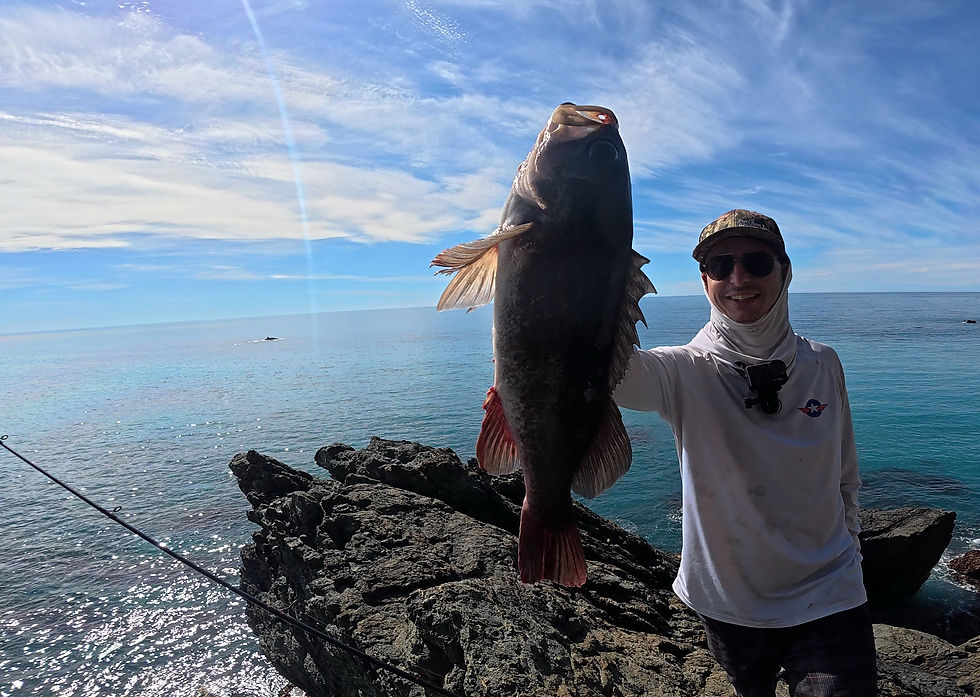
“Oh yeah, it's a black. It's a nice one.”
“That fish just made my trip.”

My first-ever black rockfish. A solid 20-incher.
It measured about 20 inches.
“Look how gold the eye looks.”

“Looks like a grouper.”
We both agreed these might be the best-looking rockfish.
It's not the color.
It's the shape.

“I was lucky to land it because there's a rock down there that it got hung up on. I just hail Mary'd it, and he got free.”
26. BROOM TAIL VS. FORK TAIL
Last session.
Time to top off that rockfish limit.
We tried a shallow reef.
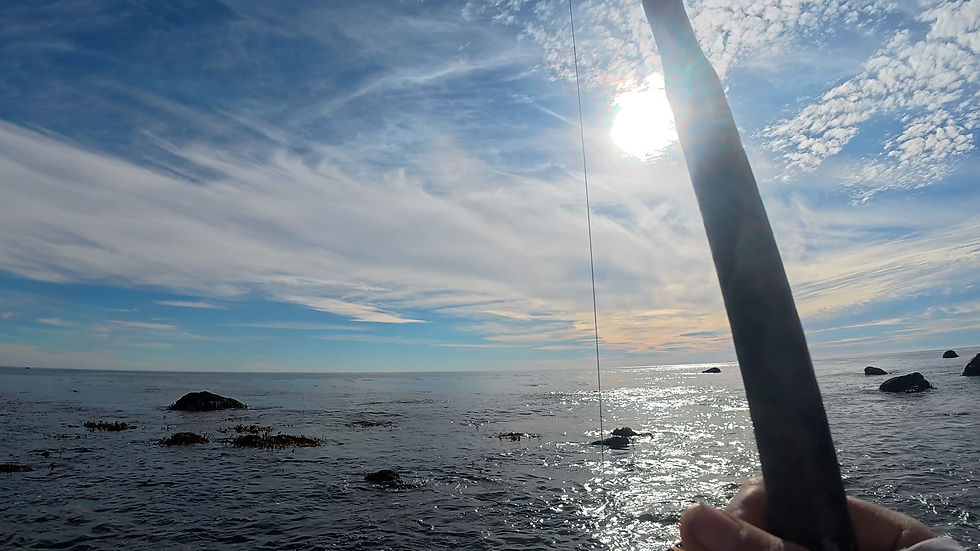
Honestly, it was probably my least favorite spot of the trip.
But it still gave us a couple more fish.
Sometimes that's the thing about Big Sur.
Even the spots that don't look all that impressive can still surprise you.
“Black and yellow, baby.”
Then, a lesson from the tail.
You'll often find a broom tail on bottom-dwelling ambush predators.
It gives them a quick burst of power for short attacks.
That's perfect for fish that spend most of their time hiding in structure, waiting for prey to come within striking distance.
They're territorial.
They live in one area.
They're not migrating.
They're not pelagic.
This fish wants to sit in a hole and hang out all day.
Now compare that to a forked tail.
That tells you the fish swims a lot.
Mackerel, bonito and tuna spend much of their lives on the move.
Or a fish on a sandy beach, fighting current.
The broom tails hang out at the bottom.
They're called groundfish.
“It kind of helps you understand their behavior.”

27. A QUICK, HUMANE WAY TO DISPATCH ROCKFISH
Here's a tip for dispatching rockfish quickly, easily, and humanely.
Destroying the brain immediately renders the fish unconscious.
That minimizes stress, and makes sure the fish doesn't suffer unnecessarily.
The problem is, rockfish practically have a helmet on their head.
Trying to stick a knife into the top of the skull is almost impossible.
So here's what I discovered.
Turn the fish upside down.
Take your knife, go through the gills, and then straight into the brain.
Jab. Jab. Jab.
Try the other side if you need to.
Make sure you get the brain.
“As soon as I do that, they just freeze. Dead. Completely done. No movement whatsoever.”

“So I feel great about that because I want to put them out of their misery.”

28. ONE LAST CAST
“One last cast to get that last fish in the bag.”

It was so relaxing to get away from the regular grind.
To spend a couple of days trying all these different spots with my buddies.
I wanted this last cast to last all day.
Then...
“All right, guys. Check out this pretty little black and yellow rockfish I just caught. This will be number 10 in the cooler for me.”
Mission accomplished.
I only caught five fish on this trip.
It was on the slow side.
And I'm wondering if it's because the swell was so calm.
For whatever reason, it wasn't a wide open bite.
But between the five I caught and the five my buddies gave me, I now had 10 fish in my cooler.
And I could go home.

Thanks for watching.
I'll see you on the next episode.
“Fish safe, fish hard, fish legal, chase your dreams.”
JOIN THE COMMUNITY
Join us in our Facebook Group, California Surf Fishing (CSF).
Come ask questions, share your fishing reports, post photos, and connect with other California surf fishers.
Our mission is to create a safe, welcoming, and fun community where anglers of all experience levels can learn more about surf fishing in California, and help each other succeed.
And if you like reading blogs about fishing stories like these, subscribe by email at CaSurfFishing.com/blog.
