

California Central Coast Surf Fishing Adventure ft. @Bluewaterdiveshop

This blog is available as a full length video on YouTube, you can find it on my channel @VINCEGOESFISHING
From Empty Beaches to Big Fish
There is something about finally breaking away from the grind and driving the Prius along the coast.
The farther south I drove, the more the noise of everyday life seemed to disappear behind me. The plan was simple: find some fish, explore some beaches, and see what the ocean would give me.

I started in LA County, casting a lightweight swimbait, but nothing was biting. Then I met Jacob along the way.

Jacob was relatively new to California surf fishing. He had grown up fishing in the Florida Keys, but after moving to California, he decided he wanted to learn the surf before eventually moving back to Florida.
“I want to master surf fishing here before I move,” he told me.
He'd only been seriously surf fishing for about six months, mostly catching perch and croaker on Gulp Sandworms. Then he found my videos.
He started watching, went on a guided trip with Kaspar (CaliforniaSurfFishing.net), and began learning what I think is one of the hardest parts of surf fishing:
“Half of the battle has been learning the tides and learning what conditions are good.”
That day, Jacob had another milestone waiting for him. He had caught his first fish on a lure.
A calico bass.
“It was fun, man.”
He made a cast onto the reef, got hit, and suddenly his rod was bent. I looked over and saw him walking backward, cranking the fish in. I had no idea it was his first lure-caught fish.
“Congratulations, man.”
“Cheers to many more.”
And then I headed farther south. Because my own search was just beginning.
2. THREE BEACHES AND TWO TINY FISH
I spent hours looking. One beach. Then another. Then another. The birds were diving. The conditions looked promising. The water seemed like it should hold fish. But I wasn't catching anything.

After a couple of hours, I moved again. At the third beach, the water was deeper. The wind had picked up. There was more current. So I changed my setup.
I went with a half-ounce Xtra-Long-Shank Swimbait hook on the Battlestar 5-inch Rib Bait and buried the hook tip underneath the ribs inside the groove. Then I cast. And slowly retrieve along bottom..

“Fish, fish, fish.” It felt like a calico bass. And it was. One small calico. It may not seem like much, but after driving three hours and trying three different beaches, even a little success feels pretty good.

I reset the bait and went back to casting. Then something funny happened. I caught another tiny fish. “Whoa... baby Cabezon.” The fish was ridiculously small compared with the bait.
“Such a small fish. Such a big bait. Such a big hook.”
And that's actually something I love seeing. If a tiny fish can successfully get hooked on a
big swimbait, it tells me something about the lure design.

“I've said this before. If you catch a small fish on a big swimbait, it means the lure design is excellent.”
The fish weren't big. But I was learning. And that's enough to keep me moving.
3. THE BREAKWALL

The next day I tried something completely different.
I started casting lures from a breakwall at high tide.
It was a new style of fishing for me, and almost immediately I discovered a problem:
Catching the fish was only half the battle.
Landing it was another problem entirely.
“Now, how the hell am I going to land this fish?”
I had two options.
I could hoist a fish straight up using heavy braid and a powerful rod.
Or, for a truly big fish, I could use a gaff mounted on a long carbon-fiber extension pole. I eventually built one and started practicing.
Because that's part of fishing too. You don't wait until the big fish is already at your feet to figure out how you're going to land it. You prepare beforehand.
That day, a small halibut broke the skunk.

Then came another bite.
A short white sea bass came up out of the eel grass and grabbed my jerkbait.
I watched the entire fight from above.
It was almost like sight fishing.
Eventually, I gave the fish some slack.
He spit the hook.
And honestly?
I was relieved.
“Good. He spit the hook. Thank God.”
I had never watched a white sea bass bite my bait and fight right in front of me like that.
It wasn't a keeper.
But it was an experience I'll remember.
4. THE GRUNION THEORY
Later that day, I was back on the sand in front of the same breakwall.
The tide had dropped.
The surf was moving.
I got a good bite.
Missed it.
And that happens.
“I get a solid hook set about 90% of the time, but not 100.”

Still, the encounter told me something.
There was an active fish feeding in the surf.
That was enough to keep me going.
Then I had an epiphany.
If a beach is near a grunion run, the grunion are going to need sandy beach to land on.
Not rocks.
Sand.
And if the grunion are concentrated there, the predators should be concentrated there too.
“So tomorrow we're going to take this party to the edge of a sandy beach.”
I didn't have much success yet.
But I was figuring things out.
And sometimes that's what a fishing trip really is.
Not catching.
Learning.
5. CHASING GRUNION IN THE DARK
Some fish can be found almost any day.
Grunion are different.
You get a very specific night.
A very specific tide.
A very specific window.
And I had one hour.
“I got to get that grunion in the bag because I can get a jack mackerel any day of the year. A sardine, an anchovy, those are easy to find. Grunion you've got to get on a specific day, specific time.”
So I drove to a remote beach where I expected there would be few people and little light polution.
Then I walked into the darkness.
The ocean was black.
The beach was quiet.
I sat on a log under the moonlight and waited.
And eventually, I saw them.
Tiny silver bodies wriggling and flipping across the wet sand.
Grunion.
I finally had what I came for.

Then I drove home.
Around 1:00 a.m., I set up my photo studio as quickly as I could and started taking photographs.
The goal wasn't simply to photograph a fish.
I wanted to capture it accurately enough to reproduce it.
“We can make realistic, and I mean 100% realistic, 3D printed baits that look like real California bait fish.”

The photographs went to the production team.
Then came months of back-and-forth.
Comparing photographs.
Studying details.
Trying to replicate what nature had already designed perfectly.

Eventually, the work paid off.
A photographic California grunion pattern appeared on the Battlestar 115 jerkbait.
We even added a UV green stripe down the side, which is something I saw on the Grunion, but only under certain lighting conditions. This is a very special bait. A little piece of the California coast, captured in a lure. This is going to come in handy.

6. SANTA BARBARA HARBOR
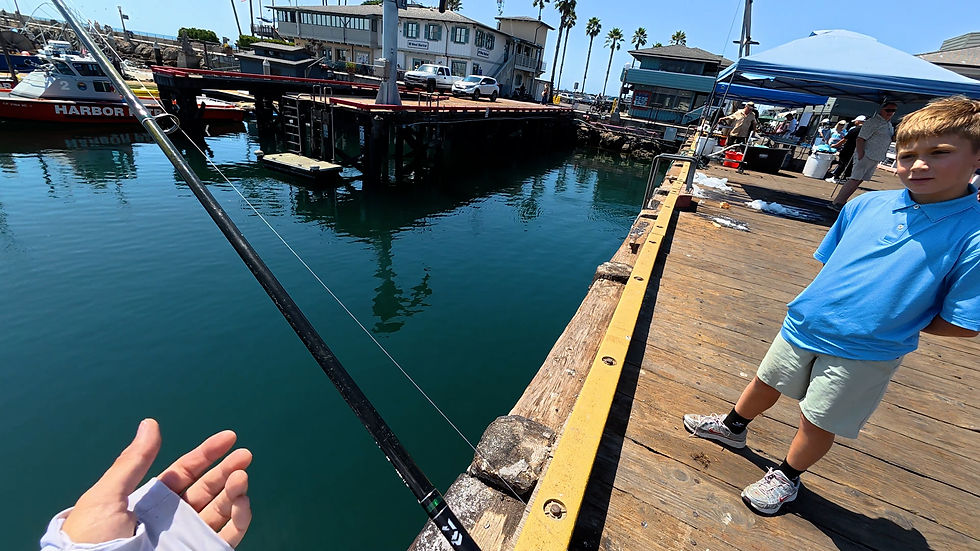
A week later, I headed back to Santa Barbara.
I walked the harbor, cast my swimbait, talked to strangers, and eventually made my way to Blue Water Hunter.

The harbor has a completely different energy from an empty surf beach.
Commercial fishing boats.
Tourists.
Divers.
Surfers.
Fishermen.
People coming and going.
And right in the middle of it sits Blue Water Hunter.
Inside, I started talking with people about fishing, bait, tackle, and the ocean.
Then I noticed something else.
The shop wasn't just a tackle store.
It felt like a little gathering place for people who love the ocean.

7. THE TACKLE TREEHOUSE
Jethro told me his relationship with the shop went back decades.
He had worked there in his 20s.
Then, years later, he eventually bought the shop himself.

Now he was running it with a very specific idea of what it should be.
The harbor serves commercial fishermen, recreational fishermen, tourists, divers, spear fishermen, free divers and ocean enthusiasts.
“We really try to service all those different populations.”
And he wanted to keep the shop local.
Local artists.
Local products.
California brands.
California fishing culture.

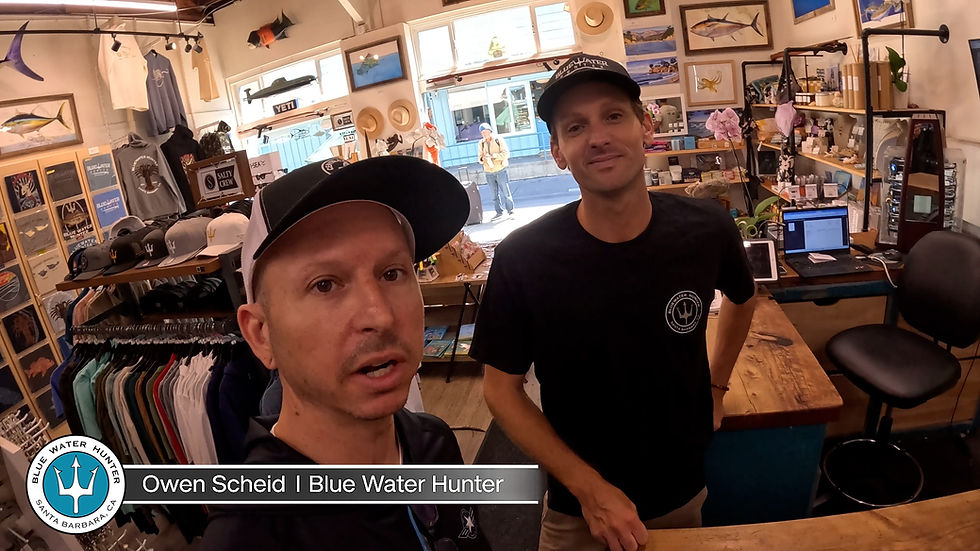
Then Owen took me upstairs. The selection kept going.
Rods.
Reels.
Jigs.
Swimbaits.
Casting irons.
Leaders.
Braid.
Kite gear.
Everything from calico bass to sea bass, halibut and tuna.
I looked around and said it felt like a tackle treehouse.
And that's exactly what it felt like.
A little upstairs world completely dedicated to ocean fishing.

8. WHY I FISH
Somewhere along the way, the conversation turned much bigger.
Why do we do this?
Why spend hours standing in cold water?
Why wake up before sunrise?
Why walk miles of beach when there might not even be a fish there?
My answer is curiosity.
“It could be boring if you're not interested in it. But if you're interested, if you're curious, then there's so much to think about and explore and learn about.”
Every time I go fishing, I learn something.
And every answer creates another question.
There are plenty of grueling moments.
Cold water.
Slippery rocks.
Early mornings.
Wind.
Sand everywhere.
But every once in a while, all that work produces an incredible moment.
A fish.
A fight.

A discovery.
And that's what makes the reward feel so much bigger.
“I don't go out there expecting to catch fish. I just hope to learn something new.”

That's really what fishing has become for me.
Stay curious.
Enjoy it.
Do what you love.

9. THE REALITY OF SURF FISHING
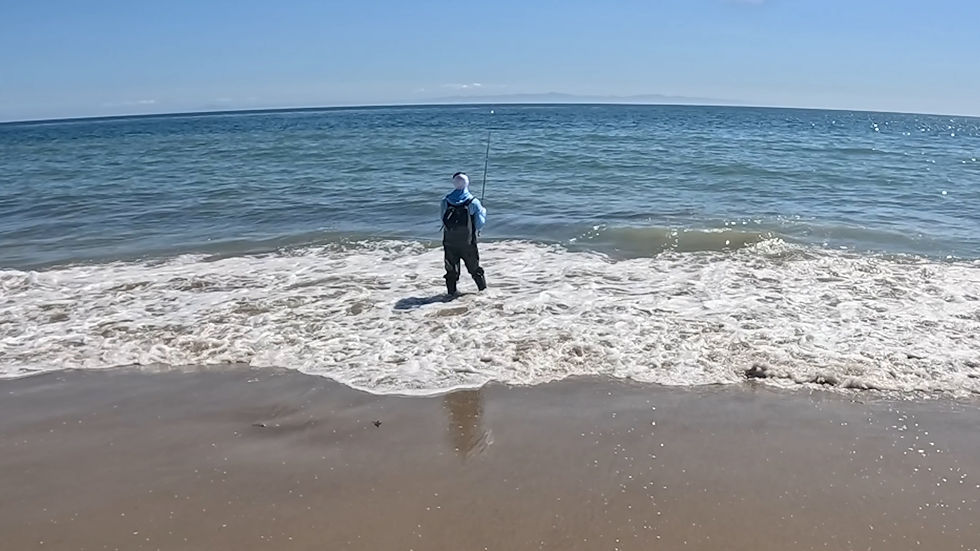
By this point, I still hadn't caught a trophy.
And I wanted to show that.
Because when you watch fishing videos, it can look like the fish are always biting.
They're not.
The real fishing happens between the exciting moments.
Walking off the beach in the dark.
Cold.
Tired.
No bites.

Rinsing the gear.
Breaking everything down.
Drying it out.

Finding somewhere to park.
Planning tomorrow.
Rigging again.
Waking up before sunrise, again.
Hours in the wind.
Sand in everything.
Walking.
Searching.
Casting.
Repeating.
“This isn't luck. It's time.”
“It's effort.”
“It's showing up when it would be easier not to.”

Every forced cast.
Every lost fish.
Every long empty stretch of beach.
It all builds.
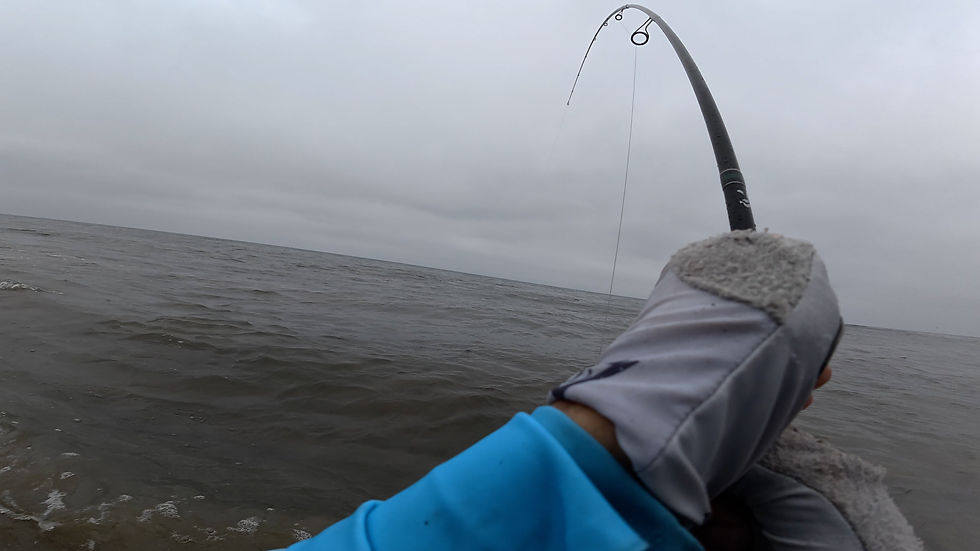
So when the rod finally loads up and you feel the weight of a heavy fish pulling back—
it makes it all worth it.
-
10. THE 30-INCH STRIPED BASS

After hours of empty water, I was standing on a beach before sunrise.
It was still dark.
I could barely see where the waves were breaking.
I was using my eyes.
I was listening with my ears.
Slowly, the gray morning revealed the whitewash and the sandbar.
I kept casting.
Again.
And again.
Then—
“Got one.”
It felt heavy.
Really heavy.
“Oh baby.”
I didn't know what I had.
Was it a halibut?
A white sea bass?
Something else?
The fish didn't fight like anything I expected to catch.

Then I finally saw it.
“A big old striped bass.”

“Oh my gosh. I just caught a 30-inch striped bass.”
The fish had eaten my bait surprisingly close to shore.
And after everything that came before it, it felt like a gift.
“That is a gift of a fish.”
I decided to give it to my neighbors.
So I strapped the fish to my back and kept fishing.

11. THE WEAVE METHOD

After the striped bass, I went back to bait fishing.
And I wanted to show a technique I've developed and shared many times.
I call it the weave method.
The idea is simple.
Wrap the squid with magic thread.
Not too tightly. Or it could cut the squid in half. Just wrap with many many gentle wraps and build up something very secure to anchor your hook to.
Then take the hook point and weave it underneath the strands.
Under.
Out.
Under again.
Out again.
Until the hook is locked past the barb. Now you're weaved.
“The hook stays wide open, the bait stays trapped, fish can't steal your bait, and you get good quality hook sets every time.”
That changes the way I fish bait. Instead of worrying that every bite is going to steal the bait off the hook, I can wait. The fish can bite. And bite. And bite. Eventually, it has to hook itself.

“I'm landing those fish.”

Then I cast again.

And waited.

@VINCEGOESFISHING demonstrates why it's important to use a long rod, and keep your rod tip up high, when bait fishing, to prevent sea weed from fouling your line.

12. THE LEOPARD SHARK

The rod loaded.
And immediately, I knew this wasn't a little fish.
“Oh my gosh, that is a big freaking fish.”
Something was pulling hard.

Changing directions.
Using my energy.
“What fish? What kind of fish is this?”
Then the thought came: “Dude, is this a shark?”
It was.
A leopard shark.
And it was powerful.
“Holy moly. This fish is fighting hard.”
Eventually the shark came into view.
A beautiful leopard shark, somewhere around three and a half to four feet long.
“Look at this thing.”
The fight was incredible.

But I didn't want to eat this fish.
So I released it.
Back into the water.
And then I went right back to fishing.

That day I would eventually catch three leopard sharks.
I also caught a California spiny lobster—which I had never caught before.
And immediately discovered why they're called spiny lobsters.
“Ouch!”
I would have loved to cook it.
But it had to go back.
And I was okay with that.

13. CATCH, COOK AND VULNERABILITY

Eventually, I decided it was time to cook the cabezon.
I cleaned the fish.
Wrapped it in foil.
And cooked it simply.
No complicated recipe.
No elaborate seasoning.
Just fish.
When I finally took a bite, the meat was steaming hot and juicy.
“Cabezon has such good flavor.”
“It has a saltiness to it. It has a distinct flavor.”
“Savory. Savory is the term for it.”
It was delicious.
But eating the fish also made me think about something deeper.
It is an incredible thing to be alive.
To eat means something else had to be alive first.
“I have to eat things that were alive.”
And that creates a kind of vulnerability.
We don't always want to think about the fact that life feeds on life.
But that's part of being alive.
For me, embracing that reality is part of embracing life itself.
“If we're going to experience life to the fullest, we have to embrace our vulnerabilities.”
We can't run from everything that might hurt us.
Because vulnerability is also the doorway to joy.
This fish gave me food.
It gave me an experience.
It gave me something to be grateful for.
And I was grateful.
“This is healthy, wild-caught seafood, and I am so grateful for it." To me, this is part of the spirituality of fishing. Accepting reality as it truly is.
Fishing is a way to embrace it.
14. WHEN THE OCEAN BECOMES ART
Sometimes fishing stops being about catching fish.
Sometimes the environment becomes the experience.

The light changes.
The wind disappears.
The water clears.
The rocks, kelp, sand and sky all seem to become part of one enormous living landscape.
“Sometimes when conditions are just right, the beauty of the environment around me becomes like three-dimensional art that I'm interacting with to harvest my wild food from.”
That's when I really understand why I love this.
The world around me becomes almost dreamlike.

Raw nature in every direction.
And for a moment, I feel like I'm stepping into it rather than simply looking at it.
“I feel a great sense of honor exercising this relationship I have with it.”
Then I cast again.
And a calico hits.
15. THE CALICO SESSION

The water was clear, even though it looked cloudy.
The wind was the only real problem.
I could see the line.
I could see the structure.
I could feel the bait.
And then—

“Calico.”
A beautiful orange- or yellow-bellied calico bass came to the surface.
The hook was perfectly set in the lower lip.
I released it.
Then I kept fishing.
Another cast.
Another fish.
Another beautiful little calico.
And that's when the whole experience came together for me.
“Every once in a while there's a session that feels different.”
Sometimes it's sunset.
Sometimes sunrise.
Sometimes fog.
Sometimes rain.
“But every once in a while, the beauty of the natural environment around me gets louder than the hunt.”

The earth.
The wind.
The salt.
The sound of waves folding into themselves.

“Perfect art.”
And for a moment, nothing else exists.
“No noise. No rush. No pressure.”
“Just breath, just water, just being here.”
“And I remember this is the real world.”

16. READING THE WATER clarity — CHOCOLATE SHAKE
One of the biggest lessons from this trip came from something that doesn't look very exciting on camera.
Water.
Specifically, brown water.
At first glance, it can look terrible.

Too brown.
Too murky.
Maybe unfishable.
But sometimes what looks like chocolate milk is actually something completely different.
I call it chocolate shake.

The difference is simple.
Get into the water.
Wait for a calm period between sets.
Look straight down.
Watch what happens when the sand settles.


If the water underneath is clear, you are not looking at low-visibility water at all.

You’re looking at clear water filled with temporarily suspended sand.
Chocolate shake, when it begins to settle down, can look like big, puffy clouds of sand temporarily suspended in otherwise clear water. The water surrounding those clouds reveals that the bulk of the water is actually clear.
The sand is getting churned up by the waves, then settling back down during calm periods and in relatively calmer pockets of water.

That’s chocolate shake.
And I love seeing it.
Because that suspended sand creates edges.
Edges where clear water meets churned-up water.
And those edges can become hunting zones. Those moments between sets when the water gets calm, I always tighten my grip just a little bit.

So don't automatically walk away just because the ocean looks brown.
Take a closer look.

17. FISHING LIGHT AND READING STRUCTURE

The more I fish, the more I realize that good surf fishing is about seeing things other people might overlook. It's in the nuisances. The details.
A hole where the waves refuse to break. A small rip current.
A crack in the reef, or a steep drop off. A subtle change in the water currents. A hole in the kelp.
I was looking at a rip current and thinking about where the water was washing through the reef.
“If there's a rip current here, there's a cut along the edge of that reef.”
That could mean a drop-off.
And a drop-off could mean fish.

I like fishing light.
A quarter-ounce hook. Or three-eighths ounce. A sensitive rod. A slow retrieve.
Letting the bait swim naturally through the water, almost like fly-lining a live bait fish.
Keeping the bait 'nose-up' as it slowly sinks or gently drags along the bottom.
Let it sink slowly on a controlled, bowed line.
It’s a subtle, gentle technique.
I’m not trying to overpower the environment.
I’m trying to slide into it.
Give it a chance to sink.
Be patient.
Let it sink, if it can.
A couple of quick pops now and then to keep the line tight and controlled—then back to the slow sink.

Keep the rod tip high. The line bowed between cranks or pops.
Let it sink.
Work around the structure.
Watch the wind.
Watch the water current.
Adjust as needed. And let the bait move naturally.
That's when fishing starts to feel less like throwing a lure and more like fly lining a live bait fish in the surf zone.
The strikes become raw.
The hooksets become pure. This is the kind of fishing I dream about.
18. SHARING THE KNOWLEDGE

Along the way, I met Leland.
He was new to halibut fishing.
He had the right bait.
He just didn't have the right hook.
So I pulled one out of my backpack.
“Do you want me to hook you up, bro?”
He did.
I showed him how to rig the Battlestar 5" Rib Bait onto the 5/0 Xtra-Long-Shank Weighted Swimbait Hook.

Push. Twist.
Line up the hook with the ribs.
Tie it on.
Then bury the hook tip beneath the ribs.
And suddenly—
“Now it's totally weedless, dude.”

That moment reminded me why I enjoy meeting people on the beach.
I don't just want to catch fish.
I want other people to catch them too.
I've spent years experimenting with weedless systems.
I wanted something that could get through kelp and weeds without sacrificing hook sets.
And eventually, the Rib-Through-Groove™ idea became the solution.
Now I was watching other fishermen using it.
That's pretty damn cool.

There's something satisfying about that.
Meeting another fisherman.
Sharing something you believe in.
Helping somebody catch a fish.
And watching the idea spread down the beach.
19. ONE LAST FISH

Before the trip was over, there was time for one final session.
One last chance.
The water looked good.
Clear water.
Suspended sand.
Chocolate shake.
I believed there was good water right in front of us.
Maybe the best water on the beach.
Then—
“Fish. Fish on.”

Something grabbed the bait.
I knew what it was almost immediately.
A halibut.
A little short halibut.
Nothing huge.
Maybe sixteen inches.
But after everything that came before it, I didn't need it to be huge.
I held it up long enough to show you.

Then put it back. “Beautiful.”

And off it went.
That was the final fish of the trip.
Not the biggest.
Not the most dramatic.
But maybe that's fitting.
Because this entire journey wasn't really about one fish.
It was about all of it.
The empty beaches.
The long drives.
The cold mornings.
The strangers who became friends.
The tackle shops.
The grunion crawling across moonlit sand.
The striped bass.
The leopard sharks.
The cabezon.
The calico bass.
The missed fish.
The mistakes.
The discoveries.
The hours nobody sees.
The time.
The effort.
The curiosity.
The adventure.
And the moments when everything suddenly comes together.
I had a hell of a lot of fun sharing this with you.
And I hope you enjoy it.
“Fish safe, fish legal, fish hard, and chase your dreams.”
Thanks for coming along with me.
I'll see you next time.


